Best Car Seat for Airplane Travel (2026): Rules, Fit, Picks
Car seats
Flying with a car seat comes down to three things: the seat is certified for aircraft, it fits the row you booked, and you can carry it down the aisle. Here are the picks, the FAA rules that decide where it can sit, and the harness option for parents who do not want to buy an extra seat.
Our picks
Flying with a car seat comes down to three things: is it allowed on the plane, will it fit the row you booked, and can you carry it down the aisle. Get those right and the trip is easier. Get them wrong and you are wrestling a 25 lb seat in a space the width of a laptop.
This guide covers the seats we would actually carry on a plane, the FAA rules that decide where the seat may sit, and the harness option for parents who do not want to buy an extra seat.
For the bigger picture, see our car seat guides. If you are coming from an infant carrier, the lightweight infant car seat guide is the better starting point, and the travel stroller picks cover the airport side once you land. For the seat that lives in the car between trips, the convertible car seat guide is the next read.
What makes a car seat workable on a plane
The plane is the hard part. The seat has to be certified, narrow enough for the row, light enough to carry, and approved for the mode your child still fits.
A seat that only does one of these is a compromise. The picks below each clear the important ones.
Which car seats are certified for aircraft use?
Look for the label that says the restraint is certified for use in motor vehicles and aircraft, or check the manual. The Graco Contender Slim and the Cosco Finale DX both carry it in harness mode, so an airline will let you strap them into a passenger seat.
Do you need a car seat for a toddler on a plane?
Only if your child still fits a harness and you want them in their own seat. The FAA does not require a restraint for a child over two, and past about 40 lb the plane's own belt is the simpler answer. Under 40 lb, a harnessed seat is the safer choice.
Where can a car seat go on a plane?
In a window seat, not an exit row, and nowhere it could block an escape path. The FAA states that rule plainly, and flight attendants enforce it, so book the window and plan the rest of the row around it.
Can a car seat go in an aisle seat?
No. A car seat in an aisle seat blocks the path other passengers need in an emergency, which is why the FAA and the airlines put it in the window. If the window is taken, ask to be moved rather than wedging the seat into the middle and hoping.
How wide is an airplane seat?
The FAA's own parent guidance says a car seat should fit most airplane seats if it is no wider than 16 inches, and one carrier publishes the row envelope as 17 inches between armrests and 15 inches deep. Measure the seat's base, not its widest shell, because the base is what has to sit between the armrests.
Do you have to buy a seat, or is a harness enough?
You do not have to buy a car seat, but you do have to buy a seat for the child if you want any restraint at all. The alternative is a CARES harness, which uses the plane's own belt and weighs about a pound.
What is a CARES harness and who can use it?
The AmSafe CARES device is FAA-certified for children up to 40 inches tall and 22 to 44 lb, sitting upright in their own seat. It replaces a hard-backed seat for that window, packs in a diaper bag, and is approved for taxi, takeoff, landing, and turbulence. It is not approved in cars.
What does the whole plane-and-rental setup cost?
One seat plus the cart runs about $300, because the Graco Contender Slim is $189.99 and the Britax Car Seat Travel Cart is $109.99. The budget route lands near $185, with the Cosco Finale DX at $74.98 and the same cart. The cart costs about $35 more than a second Finale DX, so it only pays off if you fly more than once or twice a year.
The picks at a glance
Is it worth bringing a car seat on a plane?
It is worth it when you need the seat at your destination and your child still fits a harness. The seat keeps a toddler contained and familiar on a long flight, and you avoid trusting a rental seat. If your child is old enough for the plane belt, checking the seat is simpler.
Graco Contender Slim: best all-around travel car seat
The Graco Contender Slim is the seat we would buy if we wanted one car seat to cover the flight and the rental car. It is certified for aircraft use in both rear-facing and forward-facing modes, so you can keep a younger child rear-facing on the plane and flip it forward as they grow.
It fits kids from 5 to 40 lb rear-facing, then 26.5 to 65 lb forward-facing, and the headrest and harness adjust together, so you do not rethread straps every few months. It is also slim enough to fit three across in some cars, which helps in a rental.
Two things to plan for. Rear-facing install can need a rolled towel to get the right angle, and the seat is a little heavier than a dedicated travel seat when you hoist it. Both are minor next to the cost of buying a second seat at your destination.
Cosco Finale DX: best budget seat for bigger kids
The Cosco Finale DX is a forward-facing harness seat that converts to a belt-positioning booster. It is FAA approved in harness mode, so it can be used on the plane by a child who has moved to forward-facing.
It is not for small toddlers. Harness mode starts at 40 lb and runs to 65 lb, and there is no rear-facing mode at all. That makes it a travel seat for a preschooler or an older toddler, not a baby. In exchange, it is one of the cheapest and lightest seats sold at about $75, and it has an IIHS Best Bet rating for belt fit in booster mode, which covers 40 to 100 lb.
If you fly a few times a year and mostly need a seat for the rental car, this is the budget answer. It is often on sale around 15 percent off, so the low price is real. Just do not expect plush comfort on a long haul.
Does the Cosco Finale DX fit an airplane seat?
Yes, in harness mode, and its narrow shell is one of the easier fits. It has to go in a window seat like any car seat, and it will not work for a child under 40 lb because that is where the harness starts.
Britax Car Seat Travel Cart: the accessory that saves your back
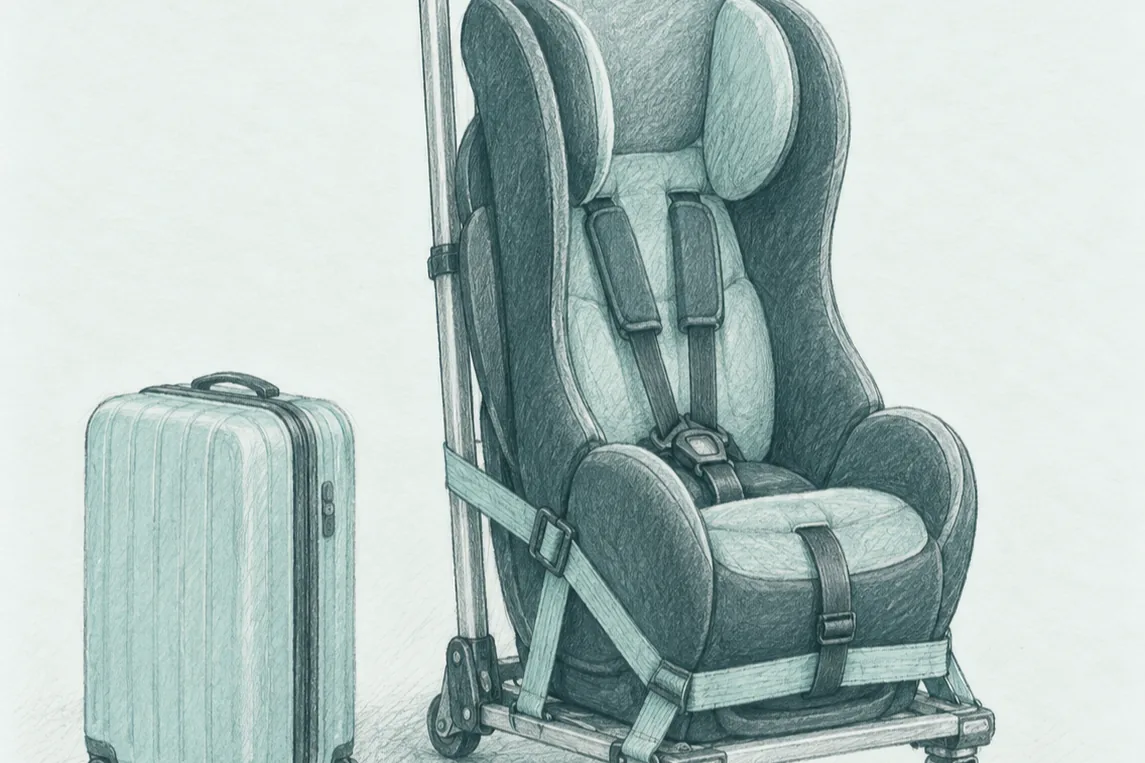
The Britax Car Seat Travel Cart is the piece that makes carrying a car seat through an airport stop feeling like a workout. You attach the seat using the same LATCH connectors you use in the car, pull the telescoping handle up, and roll it. Your child can stay strapped in the seat while you move.
It fits most car seat brands that use LATCH, and the raised platform keeps the seat off the floor. When you reach your row, the seat comes off, the cart folds, and both go overhead or under the seat in front of you.
It costs more than the cheap generic dollies, and it still has to be unloaded at your row. But for a family flying with a convertible seat, it makes the airport day much easier. It tends to pay for itself on the first trip.
Rear-facing or forward-facing on the plane
Keep your child rear-facing on the plane as long as the seat allows. It is the same protection logic as in a car: rear-facing spreads crash forces across the whole back. The FAA recommends a harnessed seat for children under 40 lb, and a rear-facing seat under 20 lb.
What is the FAA weight recommendation for a harnessed seat?
The FAA's own guidance puts a rear-facing seat under 20 lb, a forward-facing harnessed seat from 20 to 40 lb, a CARES harness from 22 to 44 lb, and the plane's own belt above 40 lb. Those bands are the packing list, in order.
Switch to forward-facing only when your child hits the seat's forward-facing weight or height limit. At that point the closed belt path matters, because it keeps the airplane lap belt off the child's back. A seat without a closed path can leave the buckle digging in for the whole flight.
Why does a rear-facing seat sometimes not fit the row?
Because seat pitch, the space between rows, varies by aircraft and cabin. The FAA's own advisory circular notes that an aft-facing seat can be moved to a bulkhead or a roomier row when the pitch is too tight. If the seat will not sit at the right angle, ask to be moved rather than forcing it.
Questions parents ask about flying with a car seat
What is the lightest car seat for flying?
The Cosco Finale DX is the lightest here at about 8 lb, light enough to carry through a terminal one-handed. The Graco Contender Slim adds rear-facing and weighs about 16 lb, and the Britax Travel Cart adds about 21 lb, so the cart is the heaviest piece of the three.
Do airlines charge extra for a car seat?
No. US airlines let you use a certified car seat in a seat you bought at no extra charge, and gate-checking is free too. You do have to buy a seat for your child, and on board the seat counts as carry-on rather than a checked bag.
Can a car seat fit in an overhead bin?
No, a full car seat will not fit in an overhead bin. A car seat travel cart does fold small enough for most bins, which is why some parents bring one. The seat itself either rides in a seat on board or goes to the gate with you.
What makes a car seat FAA approved?
Look for the label on the shell that says the restraint is certified for use in motor vehicles and aircraft, or check the manual. The Graco Contender Slim and the Cosco Finale DX both carry it in harness mode. Booster seats are never approved, because a plane seat only has a lap belt.
How do you install a car seat on a plane?
Route the airplane lap belt through the car seat belt path and tighten it until there is less than an inch of movement at the base. Rear-facing or forward-facing, the method is the same. Ask the flight attendant to confirm the seat is allowed before you board.
What happens to a checked car seat at the destination?
A checked seat arrives with the luggage, and you have no way to know what happened to it in between. Airlines are not required to replace a seat that looks fine, and a dropped or stacked seat can be damaged in ways you cannot see. That is the case for carrying the seat on board if your child is small enough to need one.
If you do check it, use a padded travel bag, put a label inside with your phone number, and inspect the shell and the harness for cracks or fraying before you install it in the rental car. A seat that has been through a rough flight is one to replace rather than guess about.
Who should check the seat instead of carrying it
Not every trip needs a seat on the plane. Check the car seat if your child is old enough for the plane's own seat belt and you mainly need the seat at your destination. Bring it onboard if your child still needs a harness, if you want them contained during the flight, or if you do not trust a rental seat.
Gate-checking is the middle ground, and it is free on US airlines. Use a padded travel bag, because cargo holds are not gentle. A light seat like the Cosco is the easiest to gate-check, and a cart like the Britax makes the walk to the gate easier.
Either way, measure your child against the seat limits before you pack. If you are not sure whether to bring a full convertible or a lighter infant seat, our lightweight infant car seat guide covers the smaller end.
Frequently Asked Questions
What car seats can I use on a plane?
Any car seat that is certified for aircraft use. Look for a label on the seat that says it is certified for use in motor vehicles and aircraft, or check the manual. The Graco Contender Slim and the Cosco Finale DX are both approved in harness mode.
Do I need an FAA-approved car seat for flying?
If you want your child restrained in a car seat during the flight, yes. Airlines only allow seats that carry the aircraft certification label. A regular car seat without that label has to be checked.
Where can a car seat sit on a plane?
In a window seat, not an exit row, and never in a spot where it blocks an escape path. The FAA states that rule directly. An aisle seat is out, and so is the exit row in front of or behind you.
Can you use a booster seat on a plane?
No. Booster seats need a lap and shoulder belt, and airplanes only have a lap belt at most seats. Harnessed car seats are the only option for a child who still needs a seat on the plane, unless you use a CARES harness.
Is it worth bringing a car seat on a plane?
It is worth it if you need the seat at your destination and your child still fits a harness. The seat keeps them contained and familiar, and you avoid trusting a rental seat. If your child is old enough for the plane seat belt, checking the car seat is simpler.
Do airlines charge extra for a car seat?
No. US airlines let you use a certified car seat in a purchased seat at no extra charge, and they do not charge to gate-check one either. You do have to buy a seat for the child.
How do you install a car seat on a plane?
Route the airplane lap belt through the car seat belt path and tighten it until the seat moves less than an inch at the base. Rear-facing or forward-facing, the method is the same. A closed belt path keeps the buckle off a forward-facing child's back.
What is the best car seat for a toddler on a plane?
For most toddlers, a lightweight convertible like the Graco Contender Slim is the best balance of weight, fit, and price. Smaller toddlers who still fit rear-facing use that mode. Older toddlers past 40 lb are often easier in a forward-facing seat like the Cosco Finale DX.
Can a car seat fit in an overhead bin?
No, a full car seat will not fit in an overhead bin. A car seat travel cart does fold small enough for most bins, which is why some parents bring one.